
_edited.png)

Rehabbing a Shoulder Labrum (SLAP) Tear: What the Latest Evidence Says

Quick Take
Many SLAP (Superior Labrum Anterior–Posterior) tears improve with structured, criterion-based rehab. Type, age, sport, and symptoms guide whether to keep it conservative or consider surgery. PMC
For persistent symptomatic Type II tears, surgeons increasingly weigh biceps tenodesis (BT) against SLAP repair, with comparable return-to-play (RTP) in throwers overall and fewer complications reported with BT in some series. ScienceDirect+1
Post-op, protect the repair early, restore ROM gradually, then rebuild rotator cuff/scapular strength and overhead mechanics—using criteria, not just the calendar, to progress. Massachusetts General Hospital+2Somos+2
SLAP Tear 101: Types & Why They Matter
The classic Snyder classification focuses on the superior labrum/biceps anchor complex:
Type I: fraying of superior labrum (biceps anchor intact)
Type II: detachment of superior labrum/biceps anchor from the glenoid
Type III: “bucket-handle” labral tear (biceps anchor intact)
Type IV: bucket-handle tear that extends into the biceps tendon(Additional expanded types exist, but these four drive most treatment decisions.) PMC+1
Who Usually Does Well With Conservative Care?
Often conservative first:
Type I (degenerative fraying): activity modification, progressive cuff/scapular loading, and posterior shoulder mobility typically suffice. PMC
Type III (bucket-handle with intact anchor): many improve non-operatively; if arthroscopy is chosen, debridement (not anchor repair) is common. PMC
Type II in non-throwers or patients >35–40: high success with non-operative care emphasizing kinetic-chain and scapular control; surgery is reserved for persistent disability. PMC

Core elements of non-operative rehab (evidence-informed):
Relative rest & irritability control, then graded exposure.
Posterior shoulder mobility (capsular stretching) and thoracic extension mobility.
Rotator cuff + scapular strengthening (lower trap/serratus), progressing from isometrics → isotonic → endurance → power/plyo.
Kinetic-chain integration (trunk/hip force transfer) and throwing-mechanics retraining in overhead athletes. PMC
When Physical Therapy Works Best
Good news: many SLAP tears heal without surgery—especially if they’re small or degenerative (wear-and-tear) rather than from trauma.

Physical therapy focuses on:
Reducing irritation and inflammation early on
Restoring shoulder mobility, especially at the back of the joint
Strengthening the rotator cuff and shoulder-blade muscles for better joint stability
Improving posture and body mechanics, especially for athletes who throw or lift overhead
Training the whole body (core and hips) to share the load during sports
Studies show that patients with Type I and Type III tears often recover with PT alone.Even Type II tears in middle-aged adults or recreational athletes often do well without surgery when rehab is done correctly.
When to Consider Surgery
Consider a surgical consult when ≥6–12 weeks of well-run rehab fails to restore function or for recurrent mechanical symptoms/instability that limit sport/work—especially in younger collision or high-demand overhead athletes. Historically, Type II SLAP tears refractory to non-operative care were repaired; modern data support biceps tenodesis as a reasonable alternative for select patients, including throwers and older athletes. PMC+2PubMed+2

As a general rule, surgery becomes an option when:
You’ve done 6–12 weeks of consistent rehab and still have pain or catching
You’re a younger athlete or heavy laborer with a clear traumatic injury
You feel instability or can’t return to sport or work despite good rehab
If surgery is needed, two main procedures are common:
SLAP repair: The torn labrum is re-attached to the bone with anchors.
Biceps tenodesis: The damaged biceps attachment is moved slightly and re-anchored, taking pressure off the torn labrum.
Both can work well. Recent research shows similar results and return-to-sport rates for both surgeries—though biceps tenodesis may have fewer re-injuries or stiffness, especially in older athletes.
What outcomes look like (high-level view):
Systematic reviews suggest BT and SLAP repair have similar RTP rates overall; some analyses note lower complications/failures after BT. Pitchers still have lower RTP than position players regardless of procedure. ScienceDirect+1
Broader concept reviews echo that BT is not inferior to SLAP repair for patient-reported outcomes and RTP in overhead athletes. eLearning Zone
Rule of thumb: Younger, traumatic instability with a clearly detached anchor (Type II) and high-demand goals → SLAP repair or BT depending on tissue quality/sport. Older (>35–40), degenerative Type II, or failed prior SLAP repair → BT often preferred.These are trends, not absolutes—shared decision-making is key. PMC

What Recovery Looks Like After Surgery
If you do need surgery, rehab is still the key to a strong recovery. Here’s what the process generally looks like:
Phase 1: Protection (0–4 weeks)
You’ll wear a sling most of the time.
Begin gentle passive motion—your therapist moves your arm within safe limits.
Focus on elbow, wrist, and hand motion and gentle scapular activation.
Phase 2: Mobility & Activation (4–8 weeks)
Slowly increase range of motion (as cleared by your surgeon).
Begin light strengthening of the rotator cuff and shoulder blade muscles.
Avoid stressing the biceps until your doctor says it’s safe.
Phase 3: Strength & Stability (8–12 weeks)
Progress to controlled strengthening with bands and light weights.
Work on posture, shoulder mechanics, and core strength.
Regain full, comfortable motion before heavy activity.
Phase 4: Return to Sport or Work (3–6+ months)
Gradual return to overhead activities or sports.
Functional testing to ensure at least 90% strength and control compared to your other arm.
Continue a maintenance program to prevent future injury.
How We Decide When It’s Safe to Return to Sport
Returning to sport after a shoulder labrum (SLAP) tear should not be based on time alone. Even when pain is gone, the shoulder may still lack the strength and load tolerance needed for sport.
To reduce re-injury risk and improve confidence, clinicians may use objective strength and force testing.
Handheld Dynamometer Testing
A handheld dynamometer is a tool that measures how much force your shoulder muscles can produce.
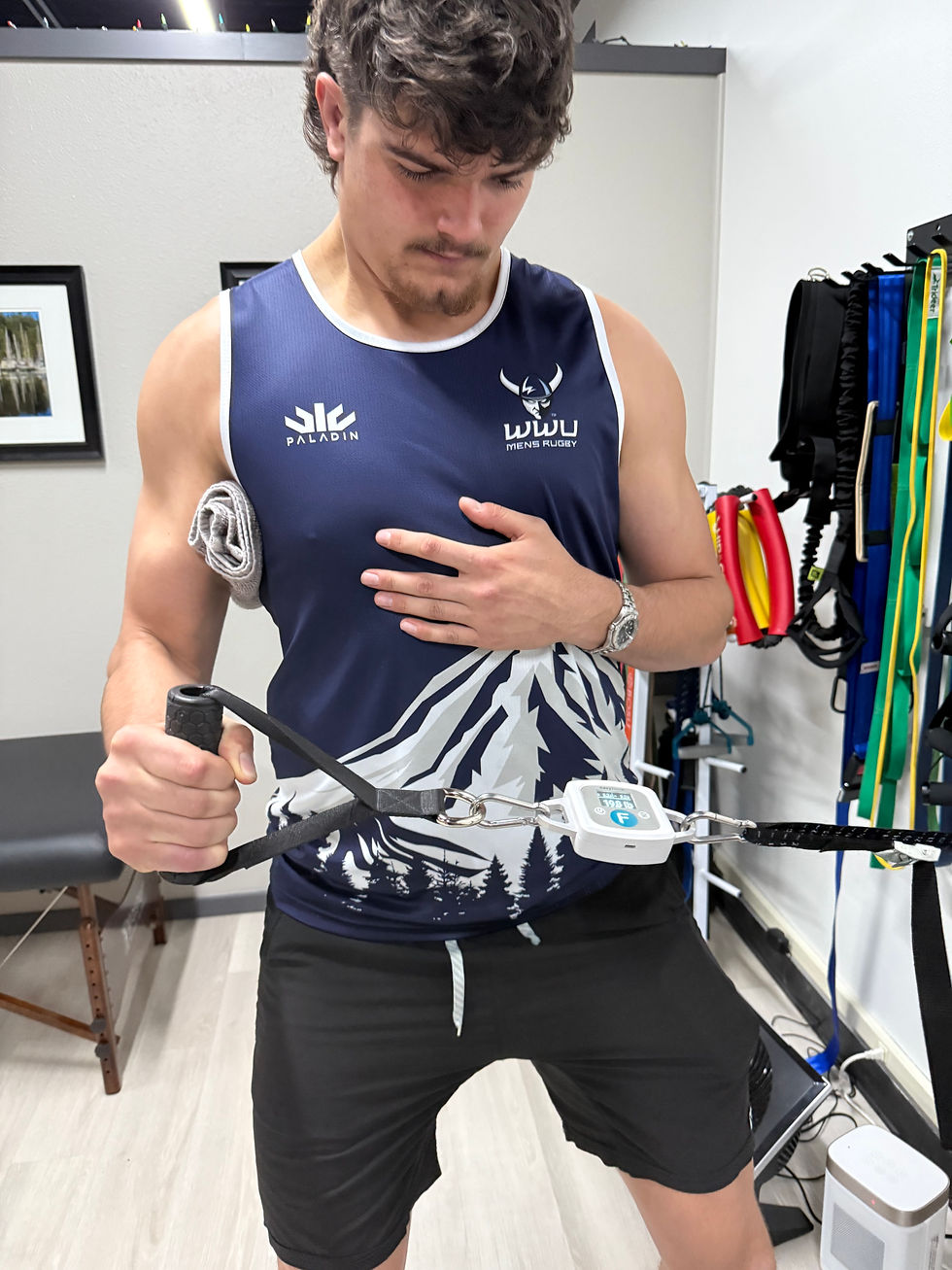
It helps assess:
Rotator cuff strength
Side-to-side differences between shoulders
Whether strength has returned to safe levels for sport or lifting
This gives more accurate information than visual strength testing alone.
ASH Test (Athletic Shoulder Test)
The ASH Test is a research-supported shoulder strength test commonly used in overhead and contact athletes.
It measures force output in three positions that reflect real-world shoulder demands:
I position: Arm straight by the side

T position: Arm out to the side at 90° shoulder abduction

Y position: Arm elevated at approximately 135° shoulder abduction

These positions help identify lingering strength deficits that may not show up during basic exercises or daily activities.
The Athletic Shoulder (ASH) Test is designed to objectively assess isometric force-generation capacity of the shoulder in positions that reflect real athletic demands. For the dominant or throwing shoulder, the goals are not simply symmetry, but appropriate, sport-specific force expression.
Force Plate Testing
Force plates measure how well your body produces and transfers force through the upper extremity and trunk.
They help assess:
Power generation
Load tolerance
Side-to-side differences
Overall readiness for sport or heavy lifting
This is especially useful for athletes returning to throwing, contact sports, CrossFit, or overhead lifting.
Why Objective Testing Matters
Research shows that returning to sport without adequate strength and load testing can increase the risk of:
Re-injury
Ongoing shoulder pain
Decreased performance
Using tools like dynamometry, ASH testing, and force plates allows return-to-sport decisions to be based on measurable data, not guesswork.
ASH Test Resources (For Those Who Want to Learn More)
The ASH Test is supported by sports medicine research and widely used in high-level rehab and performance settings. Helpful resources include:
Ashworth et al. – Original development and validation of the ASH Test in overhead athletes
VALD Performance – Clinical application of the ASH Test using dynamometry
British Journal of Sports Medicine & JSES publications – Shoulder strength testing and return-to-sport criteria
(Your physical therapist can explain how these tests apply specifically to your sport or activity.)
Summary on Return to Sport
A successful return to sport after a SLAP tear means:
Minimal or no pain
Restored shoulder strength
Good control in overhead and sport-specific positions
Confidence when the shoulder is loaded
Objective testing helps confirm that your shoulder is not just healed—but ready.
How Long Does It Take to Recover?
Every shoulder is different, but general timelines are:
Non-surgical rehab: 8–12 weeks for full recovery
After surgery: 4–6 months before starting to train sports related work and as far as 1 year post-op for actual retunr to play. Your therapist will base progress on criteria, not just time, to make sure the tissue has healed before advancing.
What the Research Says
Modern evidence shows:
Many SLAP tears can recover with physical therapy alone—especially in adults over 35.
Biceps tenodesis and SLAP repair have similar long-term outcomes; tenodesis may have slightly fewer complications.
Criterion-based rehab (progressing based on strength and motion goals) leads to better, safer outcomes than time-based programs.
(References: Ahsan & Yildirim 2016; Hester et al. 2018; Hurley et al. 2024; LeVasseur et al. 2021; Mass General Brigham SLAP Protocol 2025.)
A shoulder labrum (SLAP) tear doesn’t automatically mean surgery. With proper diagnosis and a structured, evidence-based physical therapy plan, most people can regain motion, strength, and confidence to return to what they love—whether that’s throwing, lifting, or just reaching overhead pain-free.
If pain or clicking persists after rehab, an orthopedic consult can help decide whether biceps tenodesis or SLAP repair is right for you.
References
Ahsan ZS, Yildirim E. The Snyder Classification of Superior Labrum Anterior and Posterior (SLAP) Lesions. Orthop Rev. 2016. (Open-access overview of SLAP types.) PMC
Hester WA et al. Current Concepts in the Evaluation and Management of Type II SLAP Lesions. Curr Rev Musculoskelet Med. 2018. (Non-op effectiveness; decision trends.) PMC
Hurley ET et al. Similar outcomes between biceps tenodesis and SLAP repair in overhead athletes. JISAKOS. 2024. (Comparative outcomes/RTP.) ScienceDirect
Lack BT et al. Biceps Tenodesis vs SLAP Repair for Overhead Throwers: Systematic Review & Meta-analysis. 2025. (RTP and complications synopsis.) PubMed
Shin MH et al. Biceps Tenodesis vs SLAP Repair for SLAP Lesions in Overhead Athletes: Systematic Review & Meta-analysis. 2022. (Comparative outcomes.) PubMed
LeVasseur MR et al. SLAP Tears and Return to Sport and Work: Current Concepts. JISAKOS. 2021. (Classification, RTP context.) Jisakos
Mass General Brigham. Rehabilitation Protocol for SLAP Repair – Type II. 2025. (Time- and criterion-based protocol.) Massachusetts General Hospital
Tri-Service (DoD). Shoulder Instability Post-Op Rehabilitation Guidelines. 2020. (Precautions and staged progressions; anchor-protection logic.) Somos
Sanford Health. Arthroscopic SLAP Lesion Repair Rehabilitation Guideline. 2021. (Criterion-based clinic protocol.) Sanford Health
Radiopaedia. Superior labral anterior posterior tear. 2024. (Concise classification refresher.) Radiopaedia
Parnes N et al. Establishing Clinical Significance for Patients Undergoing SLAP Treatment. JBJS Rev. 2024. (Contemporary management considerations.) PMC
Ashworth B, Hogben P, Singh N, Tulloch L, Cohen DD. The Athletic Shoulder (ASH) test: reliability of a novel upper body isometric strength test in elite rugby players. BMJ Open Sport Exerc Med. 2018;4(1):e000365. doi:10.1136/bmjsem-2018-000365. BMJ Open Seminars
Schellekens M, et al. Reliability of the Athletic Shoulder Test in asymptomatic and symptomatic overhead racquet athletes. [published online ahead of print 2025]. PubMed
Królikowska A, et al. Reliability and validity of the Athletic Shoulder (ASH) test performed using portable isometric-based strength training devices compared with force plates. [published online 2022]. PMC
Trunt A, et al. Athletic Shoulder Test differences exist bilaterally in pitchers; the ASH test detects adaptations in overhead athletes. [published online 2022]. PMC
Ogando-Berea H, Virgós-Abelleira S, Hernandez-Lucas P, Zarzosa-Alonso F. Assessment of isometric shoulder strength in swimmers: a validation and reliability study of the ASH and iASH tests. J Funct Morphol Kinesiol. 2025;10(1):92. doi:10.3390/jfmk10010092. MDPI
(Optional meta-level reference) Ulupınar S, İnce İ, Gençoğlu C, et al. Validity and reliability of the Athletic Shoulder Test: a systematic review and meta-analysis. [published online 2025].
Disclaimer
This article is educational and not a substitute for medical advice. Individual rehab and surgical decisions should be made with your orthopedic surgeon and physical therapist.


Comments